Client
Major insurance broker
A major insurance broker's white-glove service was cracking under its own growth, and the data that could explain why was locked inside Salesforce. I led the service-design engagement that diagnosed the breakdown, freed the data, and handed leadership a KPI-tied roadmap they backed in full.
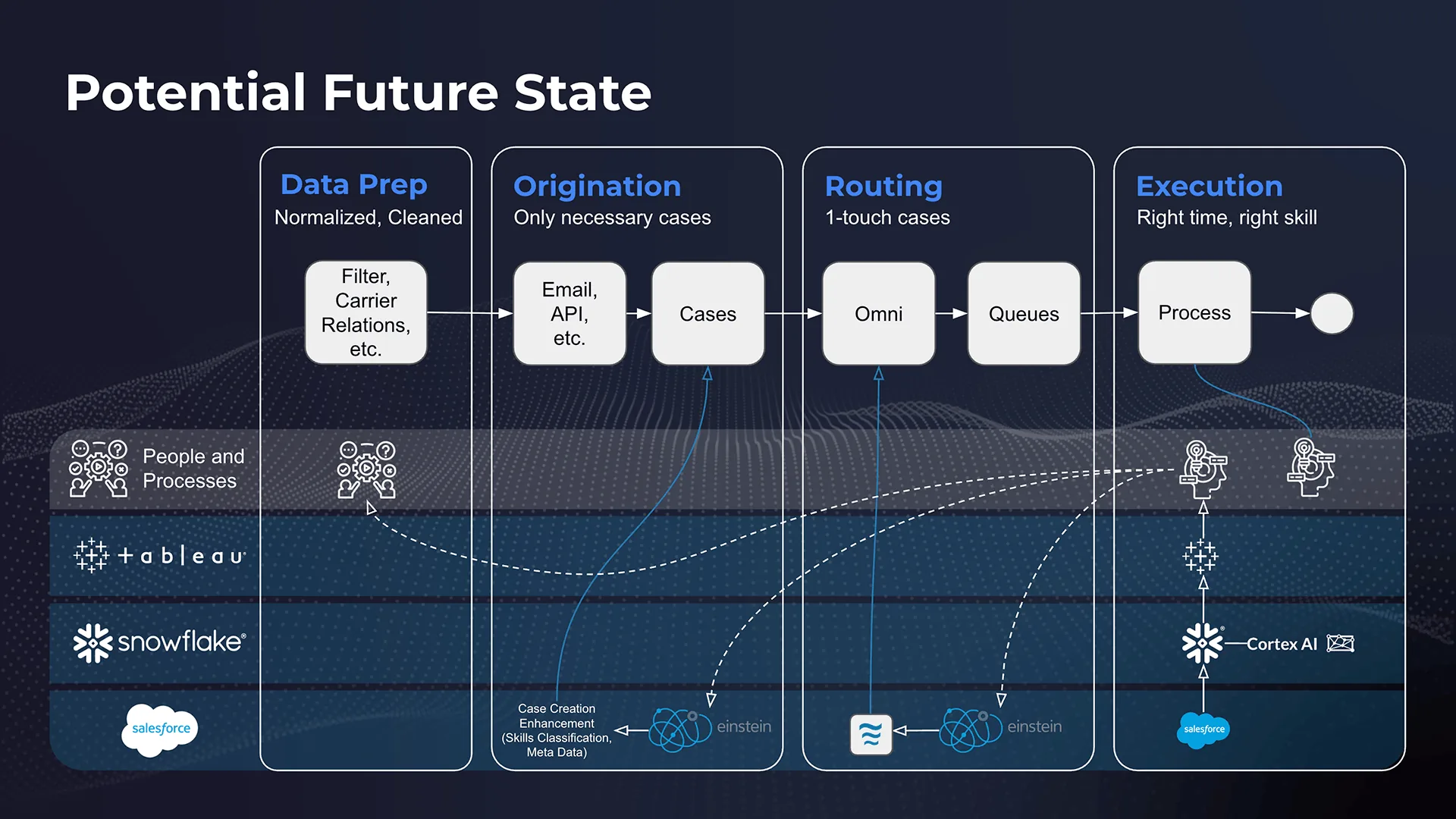
A major insurance broker built its name on white-glove service: connecting clients with the best coverage at the best price across more than 250 carriers. That high-touch experience was the whole brand.
Then the company grew, fast. As the client base expanded, the cracks in the service model began to show. The very thing the company was known for was getting harder to deliver at scale.
They brought us in to diagnose the root causes, recommend process and technology fixes, ship as many quick wins as possible, and, bigger than any single fix, make continuous improvement a permanent discipline inside the Service organization.
Exponential growth was outrunning the service model. A high-touch experience that worked at one scale was breaking at the next, and the cost landed exactly where the company could least afford it: on the client relationship that was its whole reputation.
Worse, the organization couldn't see its own situation clearly. The data that could explain where and why service was failing existed, most of it in Salesforce, but it was effectively inaccessible, so leadership was managing by instinct instead of evidence.
I knew there were issues, but I had no idea they were this bad.— A company executive, on our first findings readout
The white-glove service that was the company's entire brand couldn't keep up with the company's growth, and the data that could prove why was locked away, so leadership was running on instinct.
The instinct in a situation like this is to reach for technology: buy a tool, automate a queue, call it fixed. We didn't start there. We started by understanding the work as it actually happened: discovery interviews with stakeholders across Service and Technology, and direct observation of agents doing their jobs.
From that, our service designer L.P. and I built the diagnostic: SIPOCs, service blueprints, Voice-of-the-Customer and gap analyses, impact-versus-effort matrices, and more than twenty current-state process maps that surfaced still more opportunities for redesign and deeper integration.
Then we went after the data. The company had an abundance of Service data, most of it trapped in Salesforce. Our data team of T.S., D.G., and D.S. pushed it into Snowflake, giving everyone fast access to numbers and reporting that had been impossible weeks before. We used it to answer business questions with evidence, including validating a recent process change that had cut client case-aging by 46% in certain instances. Two workshops, one with business stakeholders and one with technology, turned the findings into a prioritized plan everyone had a hand in.
The engagement produced a pile of artifacts. These three mattered most.
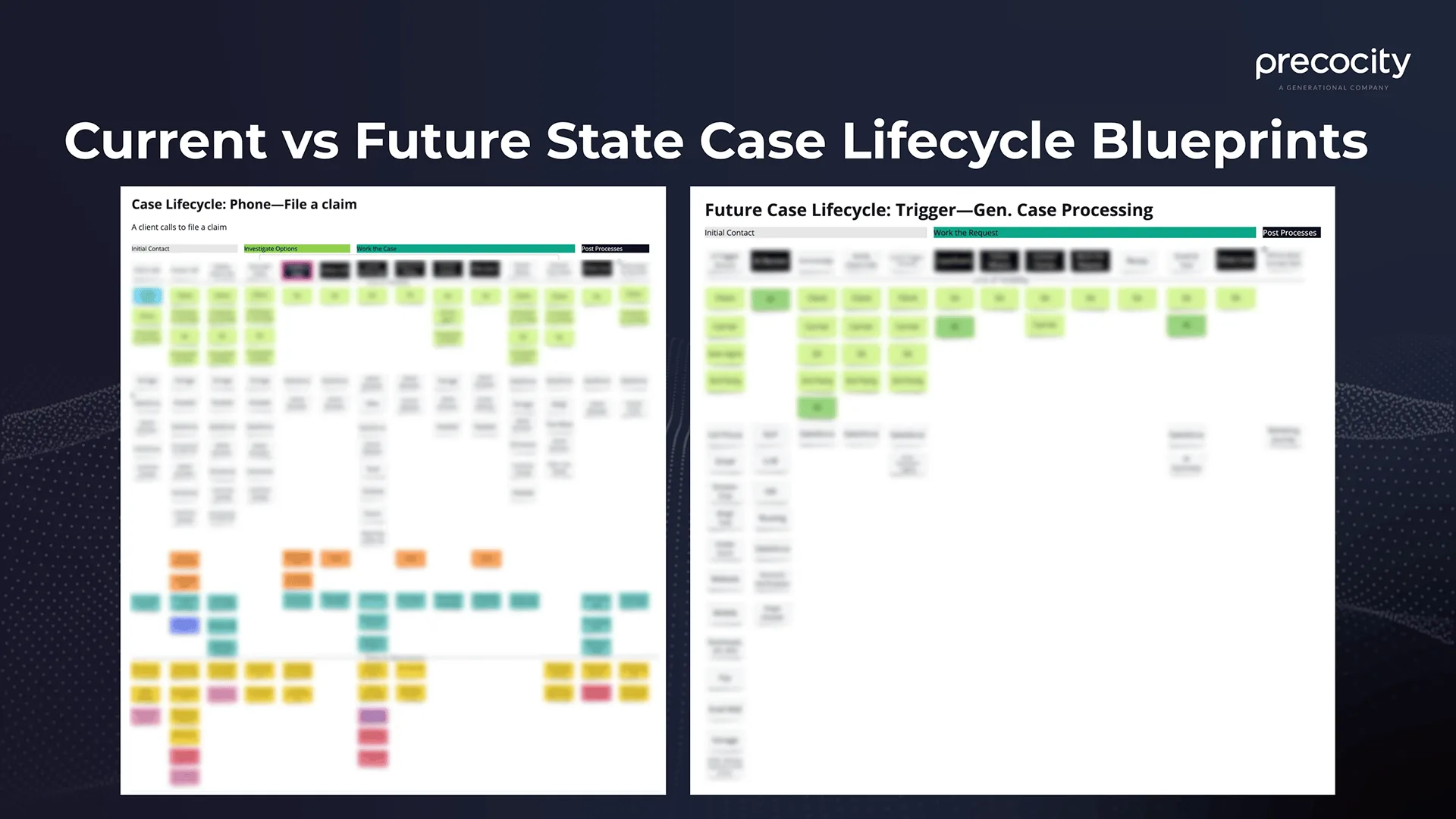
SIPOCs, service blueprints, VoC and gap analyses, and 20+ current-state process maps: the qualitative picture of exactly where, and why, the service model was breaking.
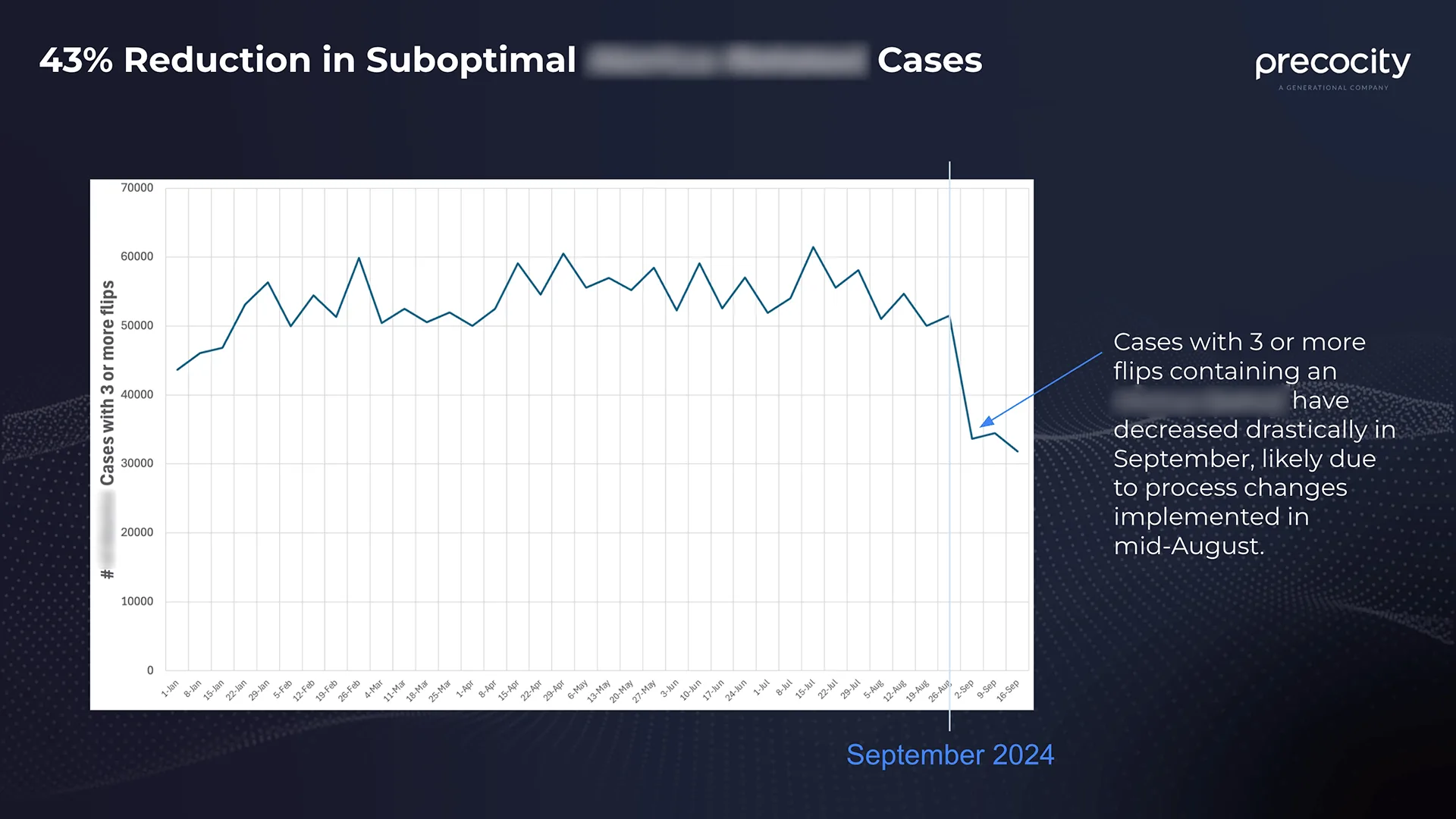
With Service data moved from Salesforce into Snowflake, the team built Tableau dashboards that became the standard for every Service report. The analysis shown here traced a 43% drop in suboptimal "flipped" cases to a mid-August process change. The same rigor validated a separate 46% reduction in case-aging.
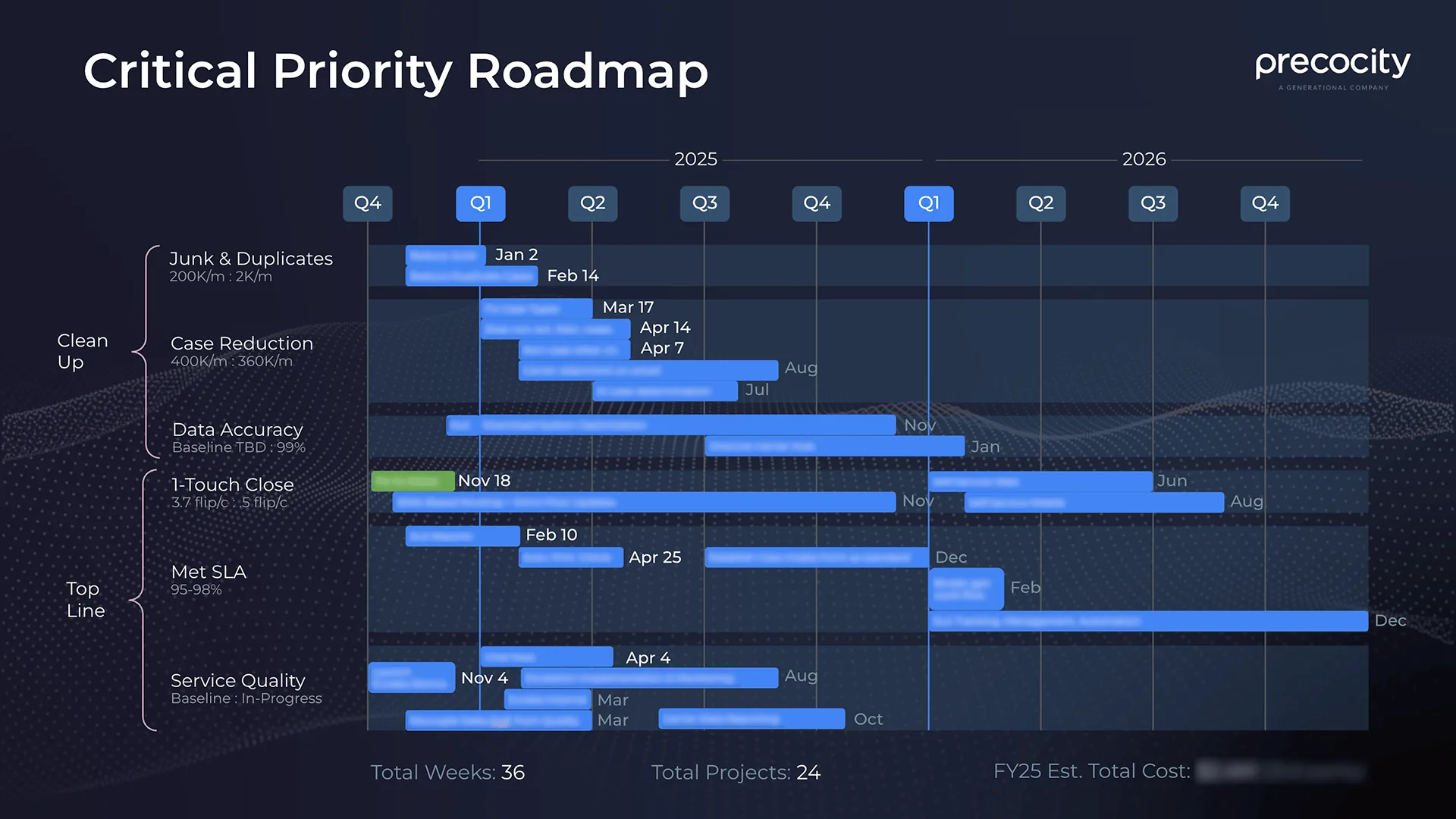
A multi-quarter plan that tied every project to a Service KPI and required cross-department collaboration, presented to executive leadership and met with overwhelming support.
"It was a well-structured approach, with broad skill sets to meet the need… [Precocity] quickly integrated to learn the various facets of the Service organization and highlighted key gaps within the Discovery phase… An extremely professional engagement, with individuals versed in multiple disciplines that helped scope and frame a complex problem."— Chief Service Officer, a major insurance broker
What I'd do differently: we should have gotten into the data far sooner. We spent most of the engagement on qualitative work, and it was good work, but we should have wrapped it sooner and gone after the numbers. Our most convincing findings came from the data, and they arrived later than they needed to.
What surprised me: how much technical and process debt a company can pile up simply because the money keeps rolling in. With no external pressure forcing better internal decisions, an organization can skip best practices during the good times and scale itself straight into pain. That pain, when the lean times come, can grow bad enough to threaten the whole org. When the money keeps coming in, nobody looks under the floorboards.
What I took with me: listen to the client's own people about their own leaders. The company's team warned me that my usual presentation style was anathema to their CEO, and coached me on how to scope and deliver, the modality as much as the decks, to earn his trust fast. I took the advice and won over a tough executive, instead of getting our recommendations dismissed over a personality mismatch. Good work nobody's willing to hear is worth nothing, which is the same lesson a global automaker taught me the hard way.